

Tomato Paste Production Equipment

At Royal Food, we pride ourselves on producing premium quality tomato paste using state-of-the-art tomato paste manufacturing equipment. From washing and grading to pasteurization evaporation and packaging, our state-of-the-art machinery ensures superior efficiency, hygiene and product consistency. As a trusted tomato paste manufacturer, we combine advanced technology with rigorous quality control to deliver the best concentrates to global markets.
Let’s see how our high-performance equipment improves every stage of production, ensuring taste, texture and nutritional value in every package.
Advanced Machinery in Tomato Paste Manufacturing Line
The machines in our manufacturing line can work together to turn fresh tomatoes into high-quality, high-quality tomato paste. The tomato paste processing plant includes the following key equipment:
1. Cleaning Machine
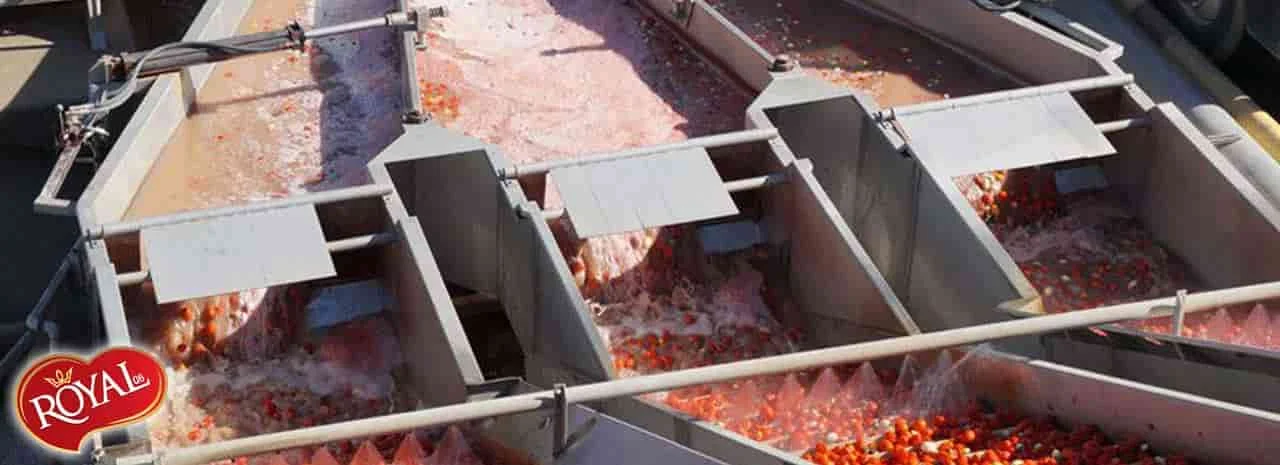
Our production line begins by draining freshly harvested red tomatoes into a sanitary basin. The system then separates mud, soil, and debris through a rigorous two-stage soaking process. High-pressure bubble turbulence thoroughly cleanses the fruit, removing all residual impurities. Finally, the water circulation pump propels the sanitized tomatoes toward automated sorting and separation stations.
2. Sorting Machine
A continuously rotating roller belt transports tomatoes through the sorting machine. High-pressure water compression nozzles administer a final wash during transit. Simultaneously, quality control inspectors stationed on the platform manually remove defective tomatoes and foreign materials, depositing them onto the waste return belt for disposal.
A noteworthy point in the tomato unloading and washing section and the sorting belt is the use of a physical water filter. The function of this filter is to control and reduce water consumption in these stages. Because the highest water consumption is also in these machines.
The system recirculates water back to the tomato unloading basin for reuse. A dedicated water treatment unit purifies the water along its return path to maintain hygienic standards.
3. Crusher
The tomatoes enter the crusher after passing through the sorting belt. This crusher has a hopper to collect the tomatoes from the inlet valve and a steel and plated blade helix to transfer and crush the tomatoes. This machine cuts tomatoes into small pieces. The smaller these pieces are, the greater the efficiency of the juice in the strainer and the lower the amount of pulp.
The crusher divides the tomatoes into small particles with counter-rotating wheels and plated cutting blades. The monopump propels crushed tomatoes into the pre-cooking chamber or preheater using pressurized transfer.
4. Pre-Heater
The preheater conducts pre-cooking operations in the tomato paste production line. As mentioned in the article tomato paste processing types, there are two types of pre-cooking methods. Both hot break and cold break processes can be performed by this device.
5. Turbo Filter
or pulper (refiner), which is located after the preheater, completely separates the skin, pulp, and seeds of tomatoes from the tomato juice.
This device features a fine-mesh screen that blocks small pulp particles. The chopped tomatoes enter a rotor through an inlet valve. This rotor has blades. The tomatoes are subjected to centrifugal force in a rotational motion and the water is quickly separated from its other components. The conical shape of the rotor ensures a uniform flow of tomatoes in it without clogging the mesh screen.
6. Juice Storage Tank
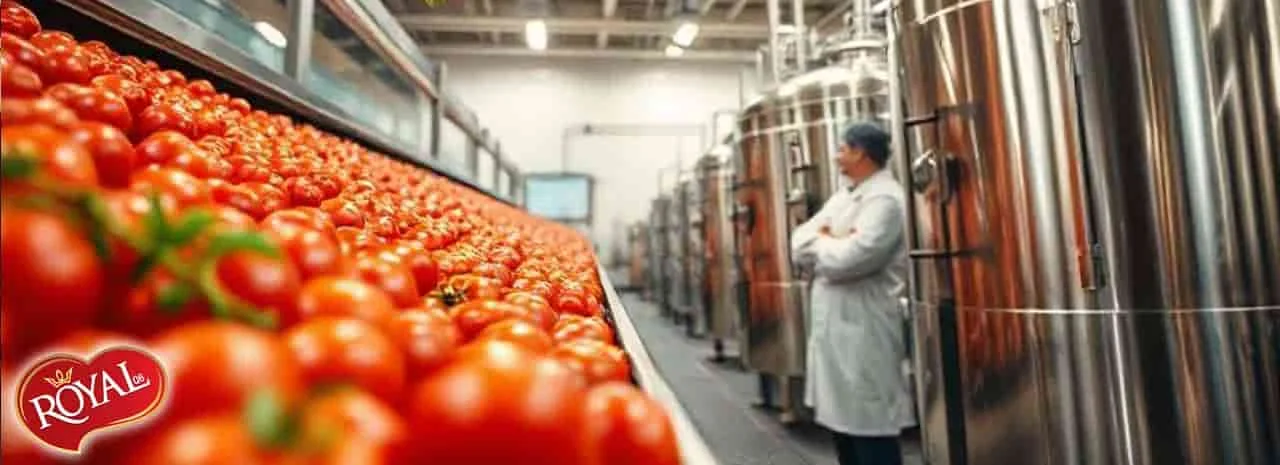
The filtered tomato juice now enters a stirred steel tank. This tank allows for the storage of tomato juice uniformly and prevents it from becoming two-phase. The device’s special stirrer creates homogeneous storage conditions, and the system maintains this uniform liquid for the concentration stage.
7. Batch Condenser (Vacuum)
The evaporation unit concentrates the tomato juice at this stage. The batch concentrator, sometimes known as a vacuum cooker, is a double-walled pot. This pot cooks using indirect heat and vacuum. The vacuum cooking mechanism gently cooks the product, ultimately preventing it from burning and producing a product that maintains its original texture and high quality.
8. Pasteurizer
According to the tomato paste production procedure, the paste must be pasteurized before filling and final packaging. Pasteurizing the paste helps both the hot filling process (filling the product hot into the container to help exhaust) and reduces the microbial load of the product and increases its shelf life. The pasteurizer device consists of paste transfer pipes surrounded by steam pipes. These pipes are reciprocating in order to increase the duration of the pasteurization process and pasteurize a higher capacity of the product per hour.
The mechanism of the device is such that the paste is inside the passing pipes for a certain period of time so that the paste temperature increases and the pasteurization process takes place in it. The system maintains this process until it pasteurizes the product and raises the paste temperature to 90°C.
9. Can Traffic Tray
After preparing the paste, operators unload cans from pallets and transfer them to the filling rail. They then load batches of empty containers onto the rotating tray for the next production phase. With each rotation, the rotating tray guides the containers to the side of the machine with the help of the centrifugal force it creates. The containers are removed from an outlet built into one side of the tray and placed on the conveyor belt of the next machine in a row.
10. Steam Can Washer
Our automated sterilization system begins when empty cans enter the steam can washer. The machine inverts each can while transporting it along a steam-pipe-equipped path. High-pressure vapor jets repeatedly sanitize the interior surfaces as cans pass multiple steam outlet nozzles. This multi-stage process ensures complete sterilization before filling.
11. Rotary Filler Machine
The rotary piston filler performs the process of filling the final product into the cans with precision and hygiene in a fully automatic manner. This machine fills the material without stopping the containers. Therefore, due to the high accuracy, the packaging speed is very high.
12. Pasteurization Tunnel
The pasteurization tunnel performs the final cooking and pasteurization process of the products after final packaging. After being capped, the cans of paste are directed to the pasteurization tunnel machine to perform secondary pasteurization on them. The conveyor system transports the product through multiple temperature-controlled zones. Each zone applies precisely calibrated heat and alternating water spray temperatures to complete the pasteurization cycle, ensuring optimal food safety and quality standards.
Final Words
You have seen that Royal Food, using the latest and most standard paste production and packaging machines, is trying to provide you with the highest quality and healthiest products. It has tried to ensure that in most parts of this process, all steps are carried out fully automatically and without manual intervention. On the other hand, the optimal management of vital energies has always been the company's concern. Experience buying standard, healthy and environmentally friendly tomato paste with Royal Food products!